Issue 56.2
Overview
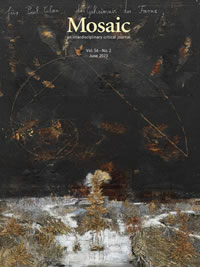
General Issue
Published: June 2023
View the issue introduction or see the issue summary and contents below.
8 essays, totalling 168 pages
$24.95 CAD
Featuring the art of Anselm Kiefer on the cover, this issue contains essays on Emily Dickinson and Daoism; death and the uncanny in Paul Celan’s later essays; power, responsibility, and the stranger in Michael Ondaatje’s The Cat’s Table; disnarration in Lemony Snicket’s A Series of Unfortunate Events; ekphrastic embodiment and material agency in Ciaran Carson’s poetry; the place of the translator in J.C. Somoza’s The Athenian Murders; and temporality and “new music.”
Dickinson’s Dew, Concentrated Casualness, and Emersonian DaoYanbin Kang In relation to Dao, Chan, and Emerson, this essay examines dew as a central trope to connect Dickinson’s letting go with impermanence, arguing that her spiritual ideals such as rat, jay, robin, pebble, weed, and drunkard tend to cease seeking, concentrate, and forget, a state of no-mind characterized by casualness. | |
Dark Inoculation: Death and the Uncanny in Celan’s Later PoetryFeng Dong In Celan’s later poetry, death becomes uncanny because the poet travels between his second and third life after the first shattering of his wholeness. His work probes the Freudian death drive and reveals the destructive potential of psychic energy, which has surpassed the natural and become a sort of metaphysical evil. | |
Power, Responsibility, and the Stranger in Michael Ondaatje’s The Cat’s TableMike Marais This essay examines the role of the stranger in developing an ethic of responsibility in Michael Ondaatje’s The Cat’s Table. It demonstrates that this figure installs a tension between the operation of power, which limits the recognition of human lives, and responsibility, which seeks to safeguard those lives. | |
Popular Genres and the Disnarrated in Lemony Snicket’s A Series of Unfortunate EventsMaryam Khorasani and Susan Poursanati In A Series of Unfortunate Events, Lemony Snicket capitalizes on the narratological concept of disnarration to present his narrative as a “better” story than the fairy tales he ardently denigrates. In so doing, he encourages the child reader to adopt a more critical approach to the narratives she engages with. | |
Beyond the Body: Ekphrastic Embodiment and Material Agency in Ciaran Carson’s Still LifeSilvia Kurr Drawing on new materialist thought, this essay explores how Ciaran Carson’s ekphrasis in Still Life unsettles the boundaries between matter and meaning, body and mind. Carson’s ekphrastic practice is performative and productive, in that it involves engagement with the material-discursive phenomena of the world and enables non-dualistic ways of thinking. | |
The Translator: A Shadow in the (Author’s) Cave of IdeasOlivera Kusovac Based on the concept of the source text invariant against the postmodern notion of truth, this essay investigates J.C. Somoza’s award-winning novel The Athenian Murders with particular emphasis on its portrayal of the translator, thus representing a case study advocating the fruitful use of translation studies (TS) concepts in literary analysis. | |
The Disappearance of Musical Futures?: Multiple Temporalities and Sonic Anachronisms in ‘New’ MusicGuglielmo Bottin With its examination of the corruptive effects of a money-oriented rural community and the “diseased” human nature encapsulated in the AIDS epidemic, Yan Lianke’s Dream of Ding Village laments the inevitable decline of the countryside in the face of the encroaching force of modernity in the process of China’s social transformation. | |
Six Popular Music Albums as Allegories of the FutureGuglielmo Bottin N/A. |